Links, finds and notes I want to share.
This guide has traced the full arc from transformer foundations through reinforcement learning for alignment to the construction of autonomo…
This chapter consolidates key equations, architecture specifications, API references, and failure mode diagnostics for rapid lookup during d…
This chapter provides a comprehensive set of questions designed to test and reinforce your understanding of the material covered throughout…
As large language models transition from passive text generators to active agents capable of planning, tool use, and multi-step reasoning, t…
The transition from a research prototype to a production-grade agent system is one of the most demanding engineering challenges in modern AI…
The history of artificial intelligence is, in many ways, a history of scale.…
As large language models evolve from isolated assistants into collaborative networks of specialized agents, the question of how agents talk…
As agents evolve from monolithic prompt-and-tool systems into modular architectures, a key design question emerges: how should an agent’s ca…
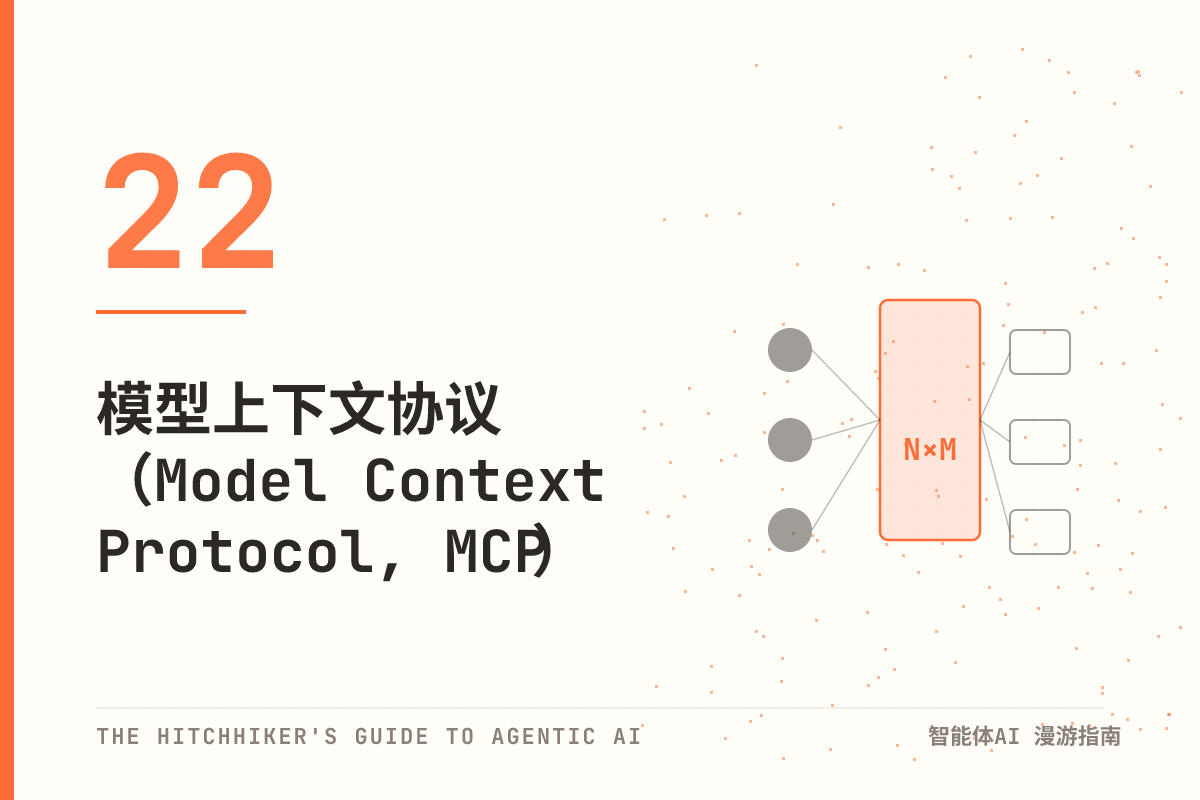
The rise of tool-augmented language models has created a fragmentation problem: every agent framework, every LLM provider, and every enterpr…
The evaluation of a conversational language model is, in principle, straightforward: present a prompt, collect a response, and score it agai…
Building effective agents requires more than a powerful model and a set of tools.…
The evolution of how practitioners interact with LLM-based agents has followed a remarkably consistent trajectory.…
Modern LLM-based agents do not operate in isolation.…
Large language models are, at their core, stateless function approximators: given a prompt x, they produce a distribution over continuations…
Retrieval-Augmented Generation (RAG) [209] has emerged as one of the most practically impactful techniques for deploying large language mode…
The previous parts equipped us with the algorithmic toolkit—how to train, align, and reason with LLMs.…
Evaluation is the backbone of any rigorous machine learning pipeline, yet it is perhaps the most underappreciated component in the developme…
The emergence of large reasoning models represents one of the most significant developments in modern AI.…
Modern LLMs are increasingly deployed not just as conversational assistants but as autonomous agents that interact with external tools, APIs…
Training LLMs with reinforcement learning from human feedback is as much a systems engineering challenge as it is an algorithmic one.…
Supervised Fine-Tuning (SFT) is the foundation of the RLHF pipeline.…
Reward models are the bridge between human preferences and the RL training signal.…
This chapter covers the family of methods that extend or replace DPO with different objectives, data assumptions, or architectural trade-off…
Group Relative Policy Optimization (GRPO) [323] is a reinforcement learning algorithm designed specifically for language models that elimina…
PPO requires 4 models in memory (policy, reference, reward model, value head), complex RL infrastructure, and is notoriously unstable.…
Problem: Vanilla policy gradient updates have no constraint on step size.…
Supervised fine-tuning (SFT) teaches a model to imitate demonstrations, but imitation has a ceiling: the model can never exceed the quality…
Reinforcement Learning (RL) is a paradigm where an agent learns to make sequential decisions by interacting with an environment, receiving r…
Modern large language models are trained and served almost exclusively on GPUs (Graphics Processing Units).…
This section covers the foundational architecture of large language models and the key optimization techniques that make training and infere…
Preface to The Hitchhiker's Guide to Agentic AI: about the author, introduction and glossary of acronyms.
Source notes, independence statement, AI usage disclosure and CC BY-SA 4.0 licensing for The Hitchhiker's Guide to Agentic AI.
Subscribe to my updates with an RSS reader.